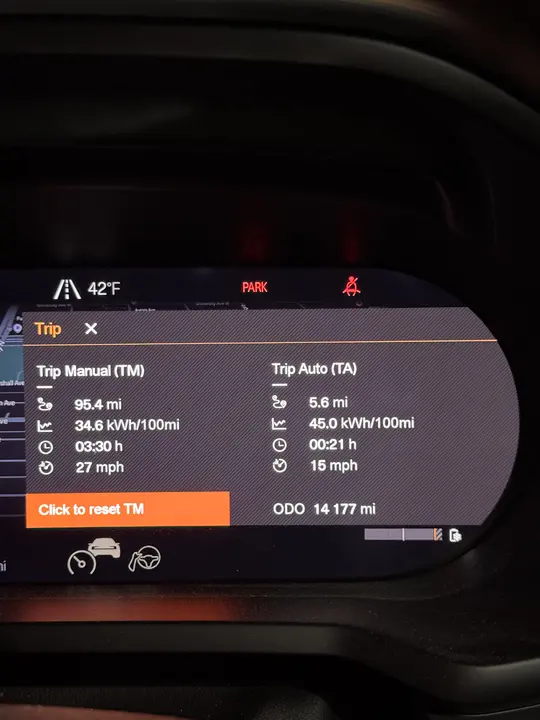
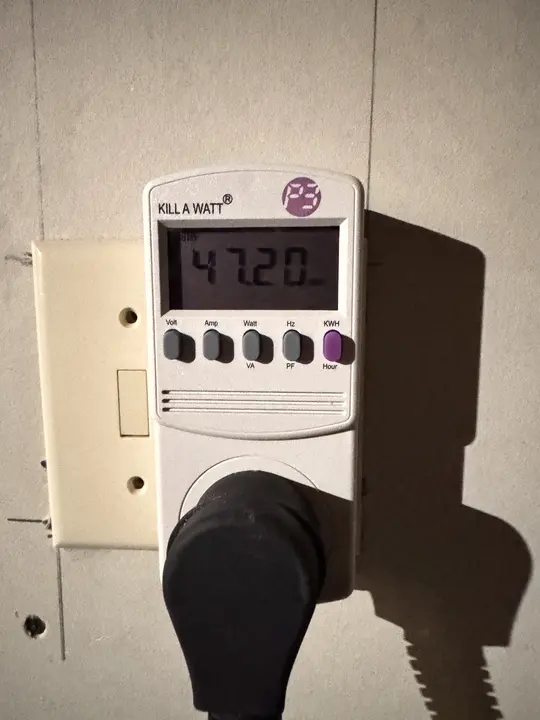
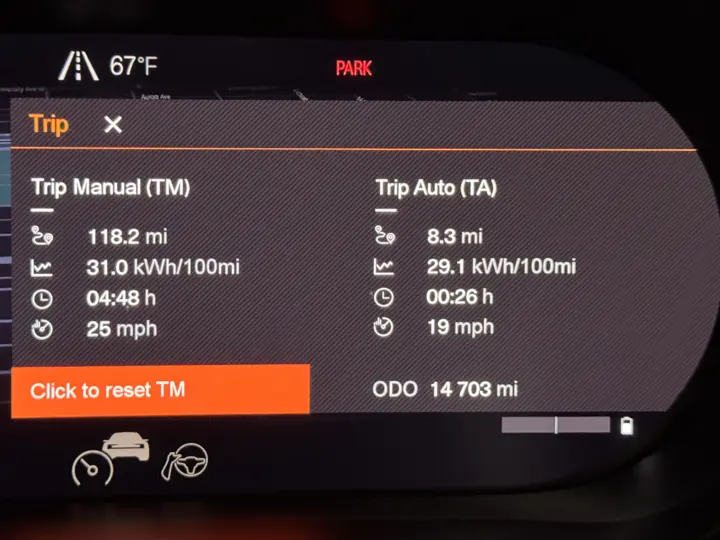
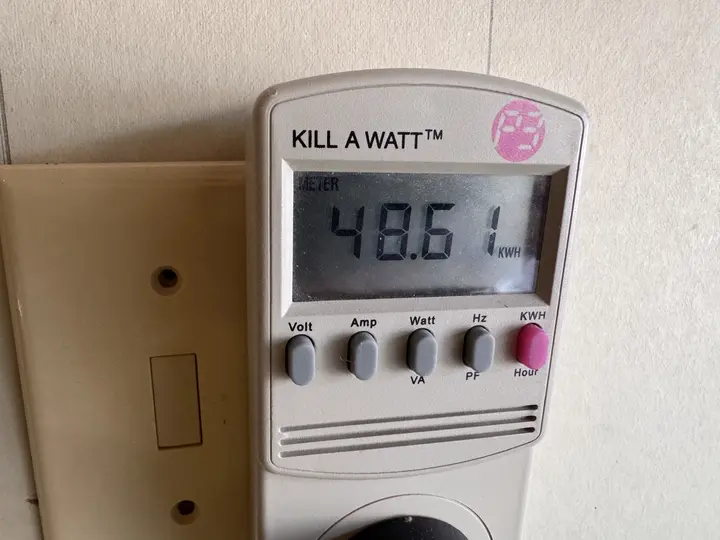
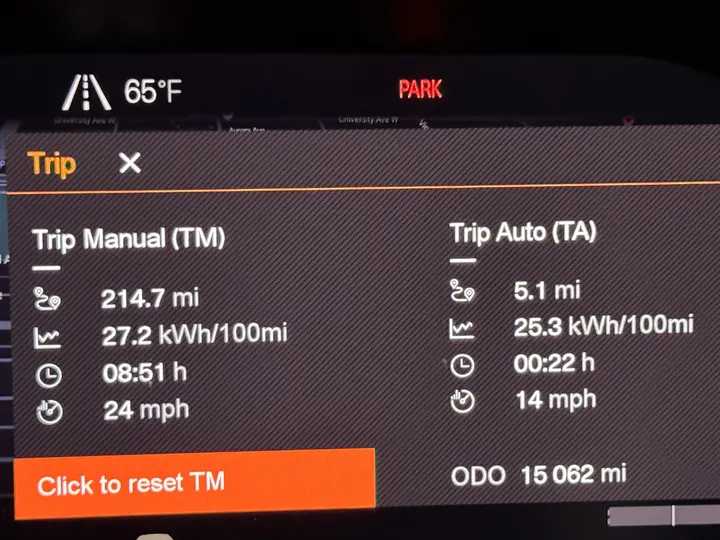
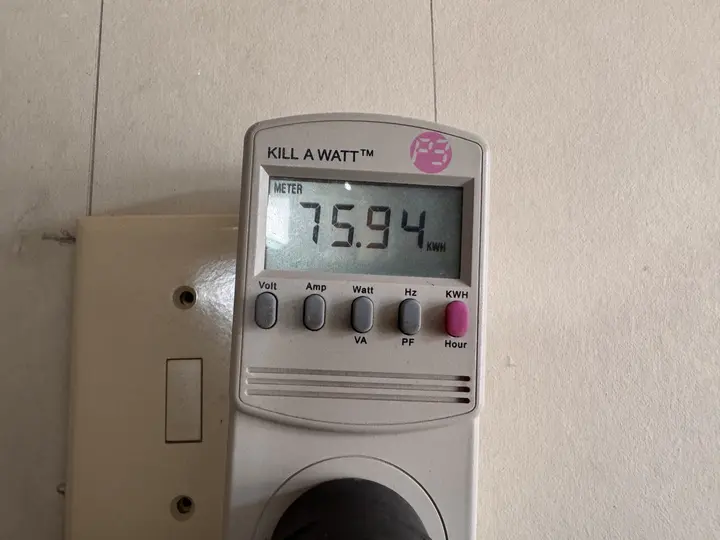
ev charging efficiency ~ ~ ~ ~ ~ i'm just trying to save money ~ ~ ~ ~ ~ if you don't care about the process you can just skip to the results i've been going around measuring the energy consumption of everything i can in my house to see if there are any obvious savings i could make. i drive an electric car (Polestar 2) and charge it in my garage so that's obviously going to be one of the top energy consumers in my house. the car will tell me how much energy it uses but i'm wondering how much it actually draws from the wall when i charge it. i don't drive a whole lot so i just use the 120V charging cable that came with the car, which is probably the least efficient way to charge it, and i'm curious just how much energy is wasted. here's the procedure i followed: i used a Kill A Watt P4400 to measure everything else so i used it with my car too. i charged the car to the manufacturer's recommended maximum value (90%) and then reset the trip computer. i drove the car about a hundred miles, then noted the energy consumption listed by the trip computer. then i charged the car back up to 90% while it was plugged into the kill-a-watt and compared the two energy measurements. trial 195.4 miles at 34.6 kWh/100 mi = 33.0 kWh of energy consumed. the kill-a-watt says the charger pulled 47.20 kWh from the wall. that means we got an efficiency of 33.0 / 47.20 or 69.9%. that seems very, very bad. this makes me suspicious that perhaps unfavorable weather (the temperature during this test was between 24F and 45F) is to blame so i plan to re-run this experiment about a month from now when the weather should be warmer. my hypothesis is that the BMS heats the battery if it's too cold while charging and that may be where the extra energy consumption came from. trial 2 i re-ran the experiment under warmer temperatures and got this result:the temperature during this run ranged from 47F and 83F, much closer to the ideal temperature for charging the battery. 118.2 miles at 31.0 kWh/100 mi = 36.6 kWh of energy consumed. the kill-a-watt reads 48.61 kWh drawn from the wall. that's an efficiency of 36.6 / 48.61 or 75.3%. that's better but still worse than i would have expected. i have a few more weeks with this car so i'll run one more trial and see if i get the same results now that the weather's more consistent. trial 3 one final trial with about the same weather. i ended up doing a lot of highway driving in the week leading up to this trial so the distance is higher and the energy efficiency of the car was lower.the temperature during this run ranged from 49F to 67F. 214.7 miles at 27.2 kWh/100 mi = 58.4 kWh of energy consumed. the kill-a-watt reads 75.94 kWh drawn from the wall. that's an efficiency of 58.4 / 75.94 or 76.9%. my lease was up so i returned the car to my local volvo dealership shortly after this trial. that'll have to be the last experiment with the polestar 2. results charging the polestar 2 using the included charging cable at 120 V trial | distance (mi) | kWh (car) | kWh (battery) | efficiency ------|---------------|-----------|---------------|----------- 1 | 95.4 | 33.0 | 47.20 | 69.0% 2 | 118.2 | 36.6 | 48.61 | 75.3% 3 | 214.7 | 58.4 | 75.94 | 76.9% discussion, future work * try some other vehicles * see how efficiency at 240 V compares to 120 V - is it worth installing a 240 V circuit just for EV charging? * how does battery chemistry affect efficiency? * does efficiency keep getting worse with more extreme temperatures? overall these results are a bit worse than what i expected but i didn't account for the overhead of the battery pack's thermal management system when temperatures were outside of its ideal range. that effect alone might explain why the numbers weren't closer to the ~80-85% i had in my head. the key takeaway for me is that i should add a 25-30% fudge factor when trying to estimate how much it'll cost to charge an electric vehicle at home. if i use a formula like this then i get pretty close to the difference in my monthly electric bill after getting an EV: (monthly mileage) * (energy efficiency) * (electric rate) * 1.25 or for me, 500 mi * 0.30 kWh/mi * 0.16 $/kWh * 1.25 = $30 - - - - - - - - - - - - - - - - - - - - - - - - - - - - - - - - written by peter beard on 2026-03-01, last updated 2026-06-25 - - - - - - - - - - - - - - - - - - - - - - - - - - - - - - - -